
Honeywell Air Duct Cleaning in Louisville: A Homeowner’s Guide
If you’ve installed a Honeywell whole-home air cleaner, media filter, or UV system in Louisville and still aren’t feeling the difference, the ductwork is almost always the reason. Honeywell equipment gets evaluated on the clean air it delivers, but it pulls that air through a duct system that’s been quietly collecting debris since the house was built. Clean the ducts first, or clean them alongside the install, and the equipment finally does what the box promised. Skip that step and you’ve paid for filtration that works hard against a losing current.
This guide covers what Honeywell’s products actually need from your ducts, when to clean versus when to install, and what to look for in any Louisville HVAC company positioning that equipment. If you’d rather have someone look at it in person, call us at (877) 517-3289 for a free estimate.
Key Takeaways
- Honeywell media filters and electronic air cleaners depend on clean, sealed ducts to perform as rated; UV lights are more forgiving but still work inside an airstream that should be clean.
- The right sequence is inspect, clean, repair gaps and leaks, then confirm the Honeywell hardware sits correctly relative to the return and supply layout.
- Bypass leaks and unsealed plenums quietly defeat filtration upgrades, no matter whose name is on the cabinet.
- Realistic performance means particle capture (PM2.5) tightens up first; VOCs and biological contaminants need source control plus adequate ventilation, and no filter alone solves those.
How Do Honeywell Products Interact With Your Ducts?
Each product in Honeywell’s lineup has a different tolerance for a dirty duct system, and knowing which is which tells you what to do first. Media filters are the most forgiving on the front end, electronic air cleaners are the most sensitive to downstream contamination, and UV germicidal lights sit somewhere in between.
Here’s the breakdown we walk Louisville homeowners through:
- Media filters and media cabinets. A thick pleated media filter captures particles on the filter face. It handles a moderately soiled duct behind it reasonably well, but the particulate loading on the filter climbs faster when the return ducts are dirty. A media cabinet only performs to spec if the cabinet is sealed to the return plenum and the return side itself isn’t leaking.
- Electronic air cleaners (the F300 family). These rely on charged collection cells to grab fine particles. An electronic air cleaner installed upstream of ducts caked with years of debris captures particles efficiently at first, then the contaminated downstream ducts re-seed the air it just cleaned. That’s why an electronic unit is the one product type where cleaning the ducts first genuinely changes the outcome. It also needs clean cells to keep its efficiency up, and cells load up faster when the upstream return is dirty.
- UV germicidal lights. UV systems are aimed at the coil and airstream, not at filtering. They’re more forgiving of a dirty duct than an electronic cleaner, but UV is a surface and airstream treatment – it doesn’t remove debris. If the ducts are loaded, the light is working in a system full of the very material you’re trying to get ahead of.
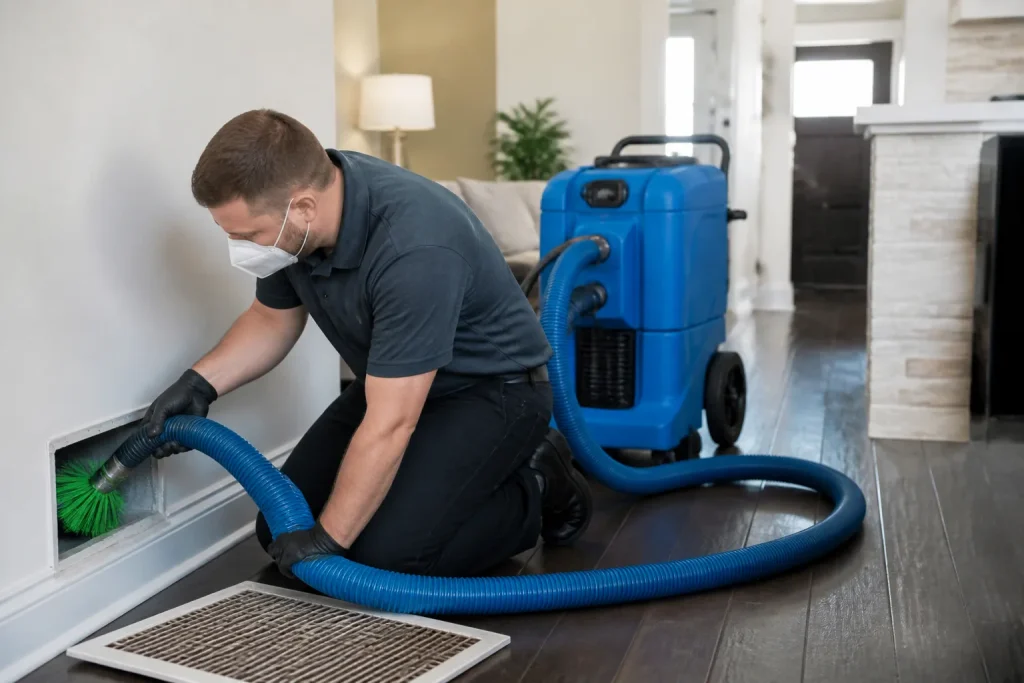
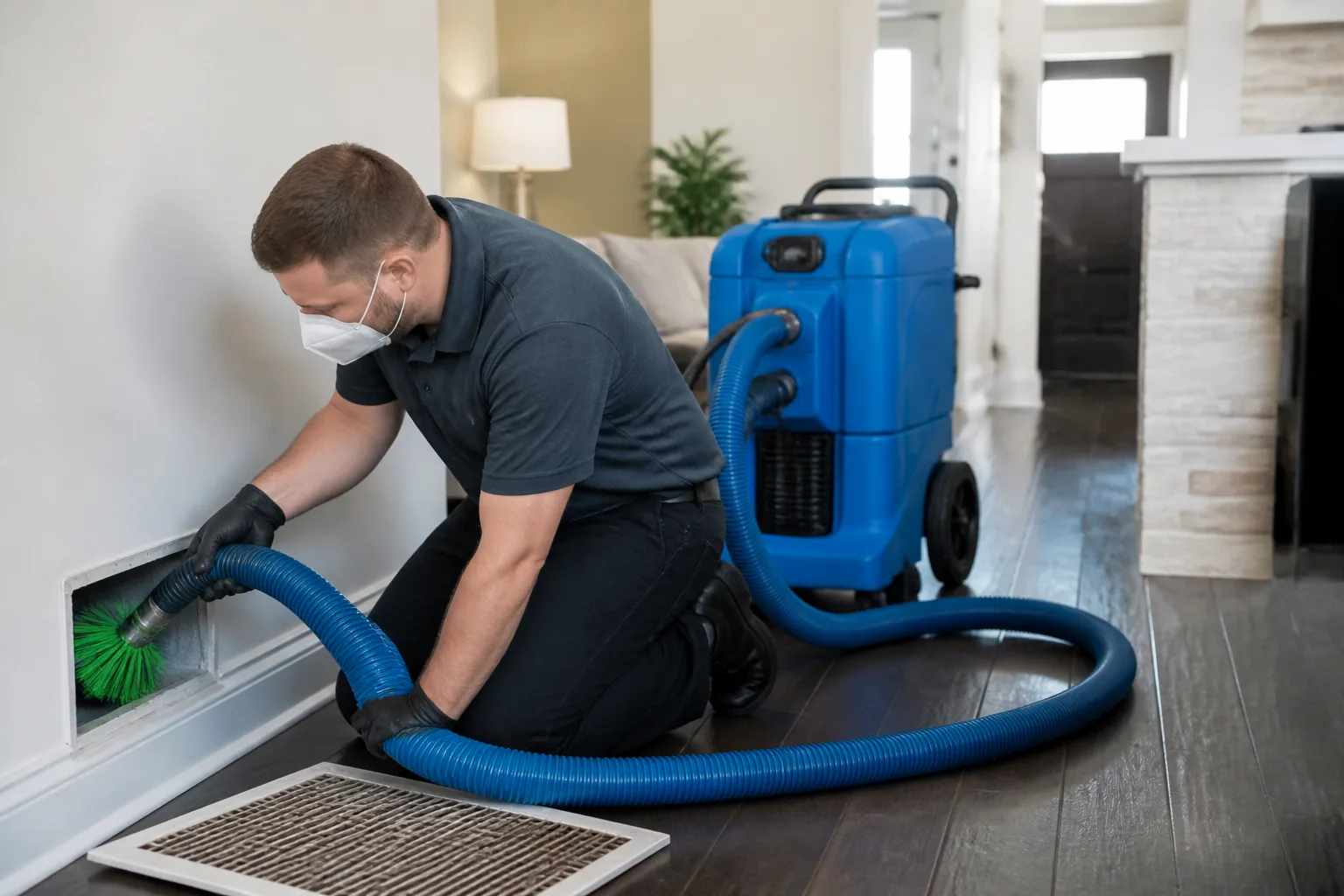
The practical answer: Honeywell equipment is only as effective as the duct system it’s installed in. When we clean a Louisville home with a Honeywell system already in place, we use a rotary contact tool from Rotobrush to loosen material on the duct walls, then a Nikro HEPA negative-air machine to hold the system under vacuum while we work. That’s the same class of equipment commercial IAQ contractors run, and it’s what lets us clean around filtration hardware instead of asking you to pull it out first.
Should You Clean Ducts Before or After Installing a Honeywell System?
Clean before you install, or at minimum clean in the same visit. The order matters because debris you leave behind will load the new hardware faster than it should and, in the case of an electronic air cleaner, contaminate the downstream ducts that feed air back to the unit. The exceptions and nuances depend on which Honeywell product you’re adding.
Here’s the sequencing that holds up in our experience across Louisville housing stock:
- Inspection first. We look inside the returns and supplies, check the plenum cabinet, and note where the Honeywell hardware will sit relative to the return and supply runs. You can’t sequence correctly without knowing what’s in the system.
- Sealing gaps and plenums. If the return side is leaking or the plenum where the Honeywell cabinet mounts isn’t sealed, filtration and pressure are compromised no matter how clean the ducts are. Fix that before or during cleaning.
- Cleaning. Rotary contact cleaning for the duct walls plus HEPA negative-air extraction to hold debris under control and pull it out of the system.
- Installing or verifying Honeywell hardware. Media cabinet, electronic air cleaner, or UV light goes in after the ducts are clean and sealed, so the hardware starts its service life on a clean system.
- Confirming performance. Check filter differential pressure, verify airflow at the registers, and confirm the electronic cells are collecting as designed.
If a Honeywell system is already installed and you’re adding cleaning later, that’s fine – just have the technician pull and inspect the cells or filter afterward, because cleaning generally dislodges material that will end up on the collection surfaces. In Louisville, where homes span a wide range of ages and duct layouts, that post-cleaning check is worth building into the visit.
What Do Technicians Look For Inside The Ductwork?
When we inspect a Louisville duct system, we’re looking for the things that undermine any filtration upgrade, Honeywell or otherwise. The most common issues break down into a short list, and most of them are invisible from the thermostat.
- Bypass leaks. Air finding its way around a filter cabinet, a coil, or a plenum joint instead of through the filter media. A bypass means the Honeywell filter isn’t seeing the air it’s supposed to clean.
- Unsealed plenums. The sheet-metal transition boxes on the return and supply sides. When they leak, the system pulls in unconditioned, unfiltered attic or crawlspace air right after the filter.
- Return-side gaps. Gaps in return trunk and branch connections pull in dust and debris from the surrounding cavity. That debris gets delivered straight to the Honeywell cabinet.
- Disconnected or crushed flex runs. A crushed section changes airflow and lets dust settle in a dead spot that cleaning alone can’t reach. That’s where air duct cleaning and Air Duct Repair work together.
- Coil access. A clogged evaporator coil upstream or downstream of a UV light short-circuits the point of the light.
This is where the service-breadth difference matters. We perform Air Duct Repair, not only cleaning – so when inspection finds a compromised plenum or a crushed run, it gets addressed in the same visit rather than becoming a note in a report. Working around Honeywell, Aprilaire, and Abatement Technologies hardware is familiar ground for our technicians, and the same inspection logic applies whether you’re on a standard media filter or a bypass-style electronic air cleaner.
How Do You Vet an HVAC Company Positioning Honeywell Equipment?
Ask the company to walk you through where the Honeywell hardware sits relative to the return and supply layout, and why. A company that can explain the placement in plain language – return-side cabinet vs. unit-mounted, in-line UV vs. coil-mounted, sealed plenum vs. open – is a company that will get the install right. A company that can’t answer those questions is pointing at a box.
Here’s a quick checklist you can use with any Louisville HVAC contractor:
- Can they identify whether the return duct feeding the Honeywell cabinet is sealed, and can they tell you why it matters?
- Do they check static pressure before and after adding a media cabinet or electronic air cleaner? A restrictive filter in a duct system designed for a thin filter can starve airflow.
- Will they clean the ducts and repair the plenum as part of the install, or hand you a separate vendor?
- Do they know how a Honeywell electronic air cleaner differs from a media cabinet in terms of what it needs from the duct system?
- Do they describe UV light accurately – as an airstream and coil treatment – rather than as a substitute for filtration?
We work with Honeywell, Aprilaire, and Abatement Technologies equipment already installed in Louisville homes, and we’re Guardsman-compatible in the sense that our service approach reflects the standards used in managed properties and multi-unit environments. When we clean a home with an existing Honeywell system, the work happens with the equipment in place, not around it. If you’d like a second opinion on placement, Louisville homeowners can call and we’ll talk through the layout.
What Can a Combined Honeywell System Plus Clean Ducts Actually Do?
Realistic expectations, plainly: a clean duct system plus correctly installed Honeywell filtration delivers measurable particle reduction in the PM2.5 size range, and the electronic air cleaners add fine-particle capture beyond what a media filter manages. What no filter system removes well is VOCs from paints, cleaners, and off-gassing, and no filter alone resolves biological contaminants without source control and adequate ventilation.
Here’s how the picture reads by contaminant type:
- PM2.5 and larger particles. Strong improvement with a clean duct system and a well-sealed media cabinet or electronic air cleaner. This is where Honeywell products are on firm ground.
- VOCs. Limited. Filtration media has some capacity, but the real fix is ventilation and source reduction. No cabinet solves this alone.
- Biological contaminants. UV lights can reduce microbial load on the coil and airstream, but source control – moisture, standing water, damp returns – is the actual fix. A UV light in a damp duct system is fighting a losing battle.
Where we’d push back on any pitch: “cleaner air isn’t a feeling” only holds if the underlying system is clean and sealed. A Honeywell system on contaminated ducts gives you a filter working harder than it should and a homeowner wondering why the difference isn’t obvious. Cleaning, sealing, and repairing first is what makes the Honeywell upgrade measurable. The name “Dayspring” is the point – the work isn’t done until the air inside genuinely feels different.
Related services in Louisville: if the inspection turns up a damaged dryer vent or a duct run that needs repair, we cover that too. Our dryer vent cleaning addresses one of the NFPA’s leading causes of residential fires, and Air Duct Repair handles the compromised runs filtration upgrades can’t fix. That full-duct coverage means one crew, not two contractors.
The Bottom Line
Honeywell’s whole-home air products are engineered well, but they can’t outrun the duct system they’re installed in. The correct order is inspect, seal gaps and plenums, clean the ducts, then confirm or install the Honeywell hardware. Electronic air cleaners need this the most; media filters tolerate a bit more; UV lights need a clean airstream to do their job. If you’re in Dayspring Air Duct Cleaning territory and want a professional inspection of both the ducts and the Honeywell equipment, we’re glad to help. Clean ducts, sealed plenums, correctly placed hardware, and honest expectations – that’s the combination that gets you what the Honeywell spec sheet promises.
If you’re in Louisville and need help, Dayspring Air Duct Cleaning offers free estimates – call (877) 517-3289. We answer 24/7. Fast dispatch from 7am to 7pm, Sunday through Friday. The price is set per job by the written estimate.
Frequently Asked Questions
Yes. An electronic air cleaner captures particles efficiently on its collection cells, but if the downstream ductwork is caked with debris, that material re-seeds the airstream and loads the cells faster. Cleaning the ducts before or alongside the install is what makes the electronic air cleaner perform as designed. It’s the one Honeywell product where the order matters most.
You can, but you’ll load the filter faster and the cabinet won’t perform at spec if the return plenum isn’t sealed. A media filter tolerates some duct soil better than an electronic air cleaner, but the right sequence is still inspect, seal, clean, then install. Call (877) 517-3289 for a free estimate if you want it done in that order.
Filtration captures particles – PM2.5 and larger – while UV lights treat the airstream and coil surfaces. They’re complementary, not interchangeable. A filter in a clean duct system tightens up particle load; a UV light adds a coil and airstream treatment, but neither replaces the other, and neither substitutes for a clean, sealed duct system. Louisville homes with damp returns need source control plus both.
Check filter differential pressure and inspect cells on the schedule your installer recommends, and definitely after any duct cleaning, because cleaning dislodges material that ends up on collection surfaces. A visual check of the cabinet seal and plenum is worth doing at the same time. Call (877) 517-3289 for a free estimate on a combined inspection and cleaning.
Written by the team at Dayspring Air Duct Cleaning, serving Louisville since 2013.
Need Air Duct Cleaning Help?
Call Dayspring Air Duct Cleaning - licensed & insured, with free written estimates in Louisville.
(877) 517-3289